
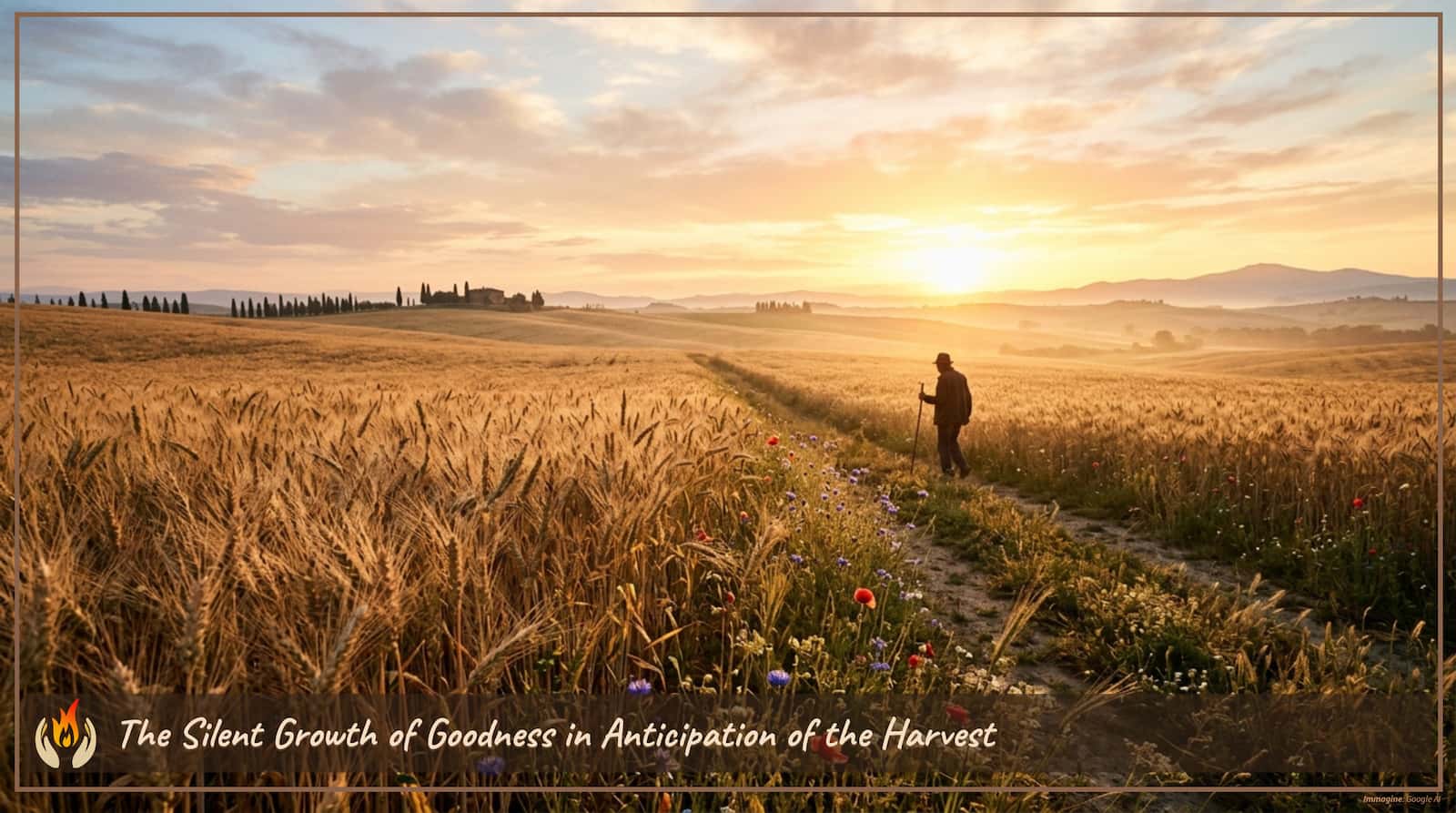
Today the Lord unveils the mystery of divine patience through the parables of the earth. In a world that demands immediate judgments, God cultivates history with faithful and gentle foresight, inviting us not to uproot prematurely what appears imperfect, but to safeguard the small seed of Goodness.
O Father, patient guardian of our history,
You who sow the good seed in the furrows of the world,
grant us clear eyes to discern the work of Your Grace,
without letting ourselves be disheartened by the shadows of evil growing beside us.
Lord Jesus, gentle Farmer,
restrain our impatient haste to judge and separate.
Teach us to dwell in time as a space for conversion,
confident that Your mercy knows how to await the day of harvest.
Holy Spirit, humble and fruitful strength,
make our hearts like the small mustard seed.
May our faith, even if fragile and hidden,
become a welcoming tree capable of offering shelter and refreshment to the weary.
Divine leaven infused into the dough of humanity,
transform our daily environments from within.
Make us instruments of a silent and constant holiness,
capable of fermenting everyday relationships with love and justice.
Accept, Holy Trinity, our supplication,
so that on the final day we may be gathered into Your barns,
shining like the sun in the Kingdom of Your Father.
Amen.
Explanation
In the passage from Matthew (13:24-43), Jesus reveals the logic of the Kingdom through the imagery of the field, the seed, and the leaven. The co-existence of wheat and weeds describes the historical condition of the Church, where good and evil intertwine. The Magisterium emphasizes that God’s patience is not indifference, but a loving pedagogy that allows time for repentance. Christians are called to flee the moralistic fanaticism that seeks to purify the world through human strength, and instead embrace the active hope of small things: a grain of faith or a pinch of leaven is enough for Grace to renew the universe.
Practical Application Points in Daily Life
- Suspend judgment: Today, avoid classifying a difficult person as “bad”; pray for their conversion, imitating God’s patience.
- Perform a small act: Sow a tiny, anonymous act of kindness, remembering the power of the mustard seed.
- Guard inner peace: When faced with news of evil or injustice, do not yield to anger, but offer a sacrifice of reparation.
- Be leaven in the family: Speak gently during a domestic argument, bringing a word that diffuses tension from within.
- Examine your heart: Dedicate three minutes in the evening to discern how many weeds (selfishness) and how much wheat (charity) dwelt in your day.
Personal or Group Reflection Questions
- Do I often experience impatience and the temptation to immediately uproot evil in others instead of converting myself?
- Do I truly believe that small daily acts of faith and charity carry the invisible strength of leaven and the mustard seed?
- How do I face the mystery of evil present in the world and in the Church without losing theological hope?
- Does my way of witnessing the Gospel resemble the patient gentleness of the Divine Farmer or the aggressiveness of the servants?
- Which part of my “inner field” needs God’s mercy most today so as not to choke the good seed?